
Accepts GoM's final recommendations without changes, say sources

It will bring 348 essential drugs under price control.

According to industry estimates, the sector's revenue would increase eight-10 per cent in 2013-14, against 12 per cent in 2012-13.

Prices of various leading drug brands will come down by up to 80 per cent thanks to the newly-approved National Pharmaceutical Pricing Policy but at the same time it will hurt investment sentiments in the country's pharmaceutical sector, according to industry bodies.

The pharmaceutical companies may suffer sales loss of Rs 3,000 crore (Rs 30 billion) if the government's span of control increases, as proposed in the new pricing policy for the medicines, a section of the industry said on Monday.

US President Donald Trump's plan to sign an executive order to cut prescription drug prices by 30-80 per cent could lead to a global price adjustment with pharma firms pushing lower-cost countries like India to raise prices, according to the economic think tank GTRI. The US move could push prices in lower-cost countries like India as manufacturers would seek to recover losses and R&D costs from these nations.

Sharad Pawar says final draft will go to Cabinet before Tuesday.

Indian equities on Dalal Street saw volatility as global market trends and fresh tariff concerns linked to Donald Trump impacted investor sentiment. Track Sensex, Nifty50 movement and key market drivers for Feb 24, 2026.
Equity benchmark indices Sensex and Nifty experienced a significant decline, primarily driven by a selloff in IT stocks due to concerns about AI disruption and renewed worries over global trade.

Any potential tariffs on pharmaceutical imports into the US are unlikely to impact the credit profiles of Indian firms except for a short-term pricing blip, according to a report by India Ratings and Research (Ind-Ra). The report stated that the US generics market contributes around 35 per cent to the total revenue of the leading Indian pharma firms.

The fiscal tilt towards capex benefits companies in investment-related sectors like capital goods, defence equipment, engineering & construction and metal & mining. The planned cut in revenue expenditure will weigh on companies in consumption sectors like FMCG, consumer durables and retail.

Hit by the new drug pricing policy and regulatory interventions, growth rate of the Rs 72,069-crore Indian pharmaceutical market has slowed down to 9.8 per cent in 2013 as compared to 16.6 per cent in 2012, says a report.

Ties between India and the United States have been strained in recent years because of trade policies and patent disputes.
The move is in line with the NPPA's recent policy of putting a cap on prices.

Replying to supplementaries during Question Hour in the Lok Sabha, minister of state for chemicals and fertilisers Srikant Jena said the National Pharmaceutical Pricing Authority has been asked to look into demands for bringing 23 anti-cancer drugs within the ambit of price control.
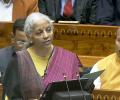
Budget 2026 sticks to fiscal discipline, shuns populist measures despite five key state elections coming up, but ends up rattling stock markets with a higher transaction tax on derivatives trading.
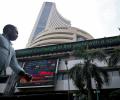
Among the Sensex firms, Bharat Electronics Ltd, Mahindra & Mahindra, Adani Ports, HCL Technologies, Eternal, Infosys, Bharti Airtel, Sun Pharmaceuticals, Larsen & Toubro, Hindustan Unilever and UltraTech Cement were the gainers. Bajaj Finance, Tata Motors Passenger Vehicles, Kotak Mahindra Bank, PowerGrid and Tata Steel were among the laggards.
As the potential threat of a steep 200 per cent tariff on pharmaceutical imports hangs in the air, analysts and industry insiders feel that focus on exports to non-US regions as well as domestic market will increase as a long-term trend. US President Donald Trump told CNBC's Squawk Box in the first week of August that planned tariffs on import of pharmaceutical products to the US could eventually reach up to 250 per cent.
The government is actively considering bringing 355 life saving drugs under price control and take a few additional measures to help the poor and below poverty line (BPL) families, once the Union Cabinet approves National Pharmaceutical Policy.

The latest price revision includes mostly cardiovascular drugs, anti-bacterials, anti-herpes, contraceptives and gastrointestinal medicines

The National Pharmaceutical Pricing Authority will soon notify prices of as many as 150 packs of essential medicines in line with the new pharma pricing policy, according to official sources.

India's pharmaceuticals and medical devices industries are still hopeful that trade negotiations with the US could cut a fairer deal for both sides, after President Donald Trump announced a 25 per cent tariff rate on India on a social networking platform without divulging the finer details.

It brought more drugs under control, cracked foreign firms' patents and introduced new regulations when MNCs acquire Indian cos.
.jpg)
The move is expected to delay the introduction of low-priced medicines in the market.
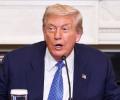
Donald Trump's tariffs, meant as political punishment, have avoided the predicted chaos, lifting US growth, weakening rivals, and letting him claim victory in a resilient global economy, observes T T Ram Mohan.

Any industrial policy is only as good as how it is applied and the other reforms that support it. This was as true 40 years ago as it is now, points out Debashis Basu.

Since items in the 12% category account for only about 5% of total GST, the additional boost to consumption may not be significant, points out M Govinda Rao.
.jpg)
Firms are mandated to change prices of medicines within 45 days of NPPA's notification.

If India caves in to US pressure as Trump hopes it will, he will further try to blackmail it into submission, points out Ramesh Menon.

"These latest so-called 'Liberation Day' tariffs are reckless and self-destructive, inflicting financial pain on Illinois at a time when people are already struggling to keep their small businesses afloat and put food on the table."
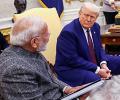
To those who ask, "Is all this really worth it? Why can't domestic demand fill the gap?", it is important to remind them that only 13 economies since the Second World War have grown at 7 per cent or more for 25 years -- like India needs to. They all had one thing in common: Strong export growth underpinned by strong global engagement, explains Sajjid Z Chinoy.

India's economic growth forecast for 2025 has been revised downward to 6.3 per cent, and despite a projected moderation, the country remains one of the fastest-growing large economies, supported by resilient consumption and government spending, the United Nations has said.

NPPA suggests expanding the list of essential medicines whose prices are controlled

Some of the proposals (for example trade margin calculation for imported medical devices) were not approved by the PMO and were sent back for revisions.

There may be shortage of drugs till pharmaceutical companies supply new batches with revised MRPs.
